
Present Perfect Simple
- B1+
2 x 60-minute class

In this lesson, we’ll discuss the Present Perfect Simple. We’ll learn how to construct it, when to use it, and practise using it.
Buy me a cup of coffee! ☕
If you found my materials useful and you’d like to support me, buy me a cup of coffee here: ko-fi.com/sipofenglish
Warm-up
Below is a list of verbs with their base form and simple past form provided. Your task is to fill in the missing past participle for each verb. Let’s see if you can remember them all 🙂
- eat - ate - ______ make - made - ______
- go - went - ______ read - read - ______
- write - wrote - ______ ride - rode - ______
- speak - spoke - ______ sing - sang - ______
- take - took - ______ swim - swam - ______
- give - gave - ______ begin - began - ______
- see - saw - ______ drink - drank - ______
- come - came - ______ drive - drove - ______
- find - found - ______ fly - flew - ______
- do - did - ______ forget - forgot - ______
Answer key
- eat - ate - eaten
- make - made - made
- go - went - gone
- read - read - read
- write - wrote - written
- ride - rode - ridden
- speak - spoke - spoken
- sing - sang - sung
- take - took - taken
- swim - swam - swum
- give - gave - given
- begin - began - begun
- see - saw - seen
- drink - drank - drunk
- come - came - come
- drive - drove - driven
- find - found - found
- fly - flew - flown
- do - did - done
- forget - forgot - forgotten
Theory part 1
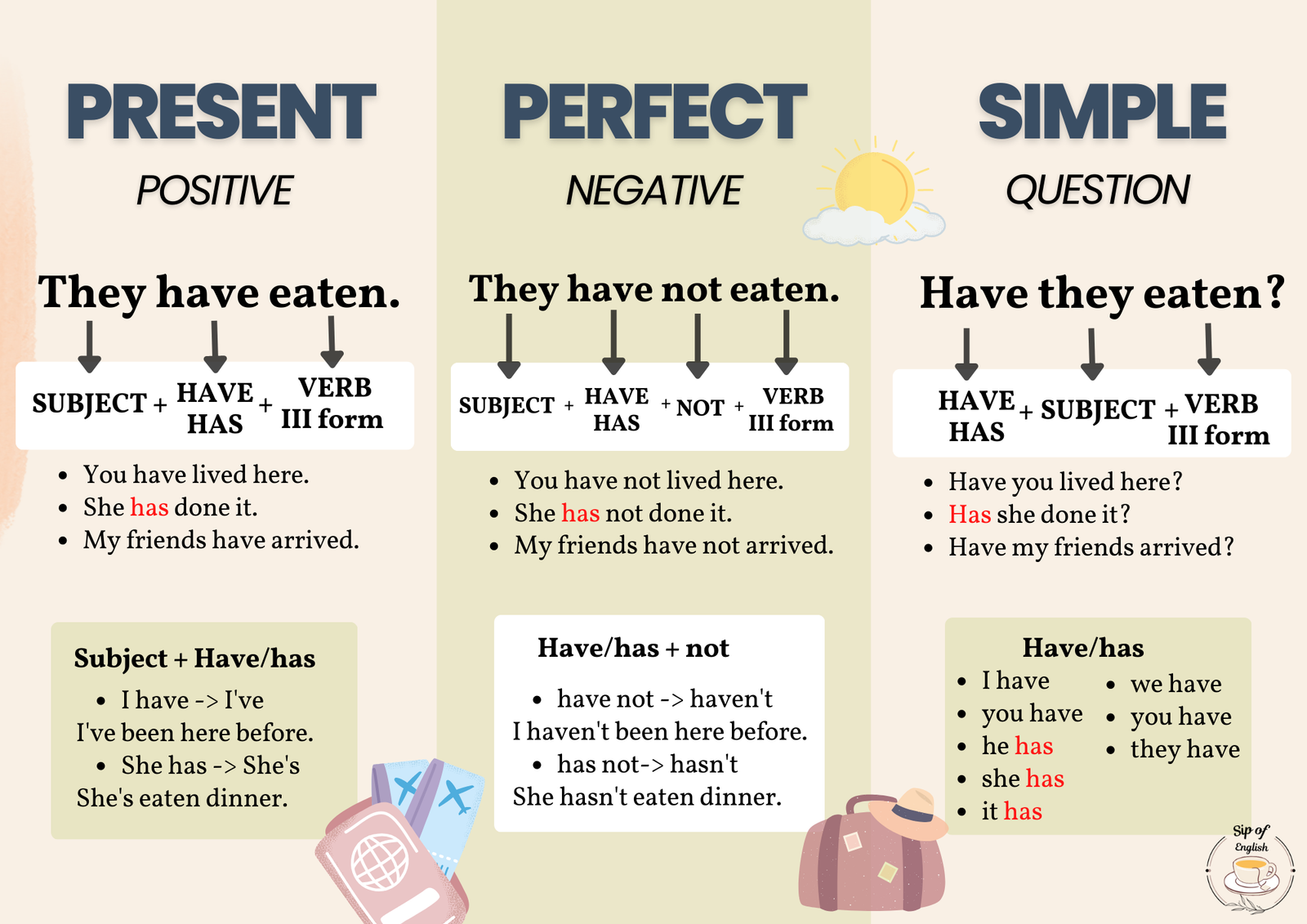
First, let’s learn how to construct sentences in the Present Perfect Simple.
Download this explanation in PDF here: link
Exercise 1
Create the missing positive sentences, negative sentences or questions.
- ➕ She has always wanted a dog.
➖ …
❓ … - ➕ …
➖ Jim hasn’t travelled around the world.
❓ … - ➕
➖ …
❓ Have we watched this film? - ➕ …
➖ …
❓ Has Janice been here before? - ➕ We’ve worked here for 5 years.
➖ …
❓ … - ➕ …
➖ They haven’t been to Japan.
❓ …
Check your answers
- She hasn’t always wanted a dog.
Has she always wanted a dog? - Jim has travelled around the world.
Has Jim travelled around the world? - We have watched this film.
We haven’t watched this film. - Janice has been here before.
Janice hasn’t been here before. - We haven’t worked here for 5 years.
Have we worked here for 5 years? - They have been to Japan.
Have they been to Japan?



Theory part 2
We know how to construct the Present Perfect Simple sentences. Let’s learn when we should use them! There are 4 rules you should remember! 🧠
Exercise 2
Watch the following clips and match the sentences to the rules:
1. Events in the past, at an unspecified time (we don’t know when they happened)
2. Recent events, at an unspecified time (we don’t know when they happened)
3. States that started in the past and last up to the present.
4. Events with obvious result in the present.
A. "Just one question, dear. You've been in this post how long, exactly?"
"Sixteen years I've lived and taught here. Hogwarts is my home.”
Check the answer
States that started in the past and last up to the present.
C. "You look well"
"Yes, I'm fine. I know I haven't written as much lately. I've been busy."
Check the answer
Recent events, at an unspecified time.
B. "They can only be seen by people who've seen death."
"So you've known someone who's died, then?"
"My mum”
Check the answer
- Events in the past at an unspecified time.
D. "Why is Marcie doing this?"
"The loneliness, the constant exile. She has gone mad."
"You think?”
Check the answer
Events with obvious result in the present.
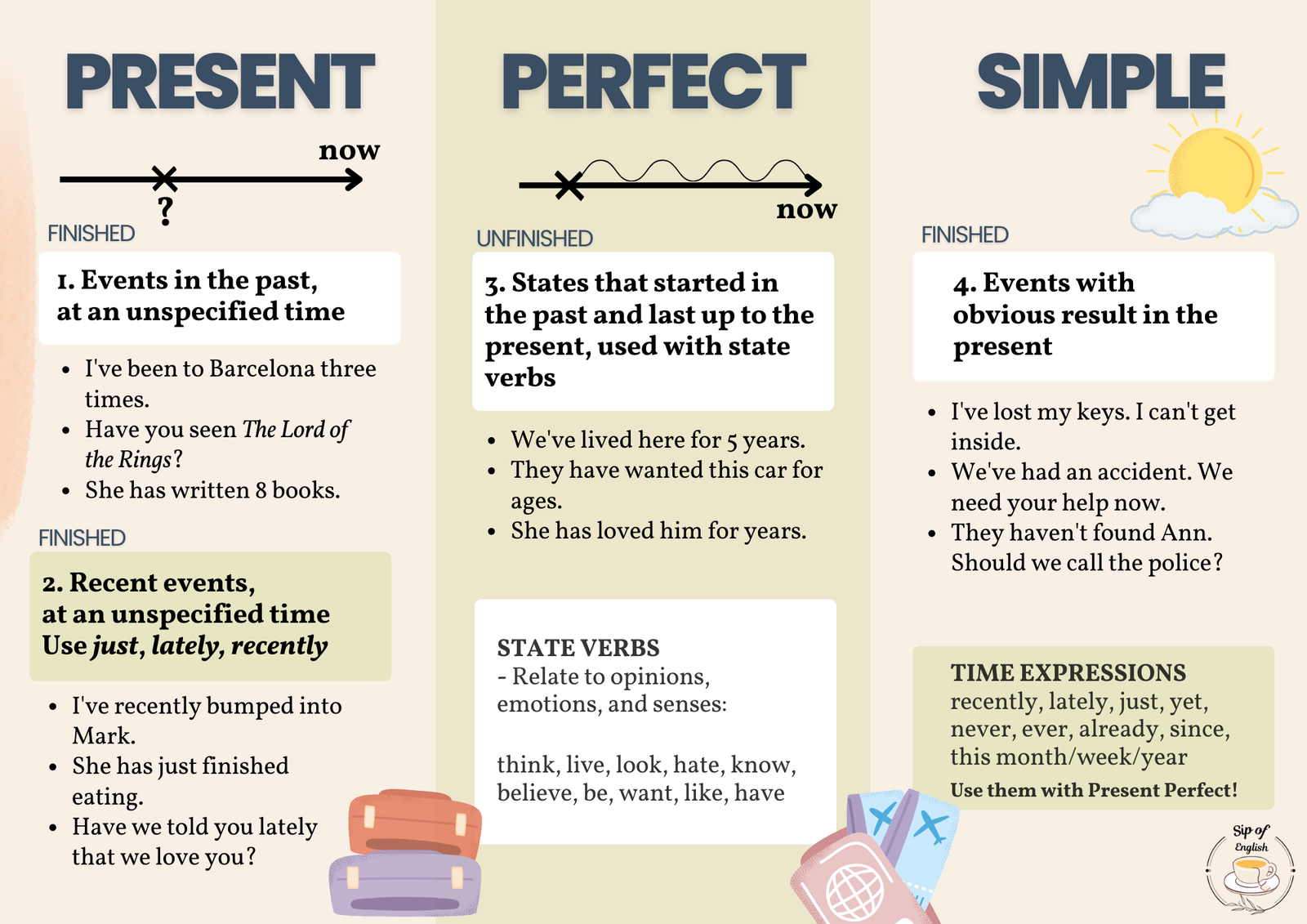
Download this explanation in PDF here: link
Exercise 3
Fill in the gaps using the Present Perfect Simple and watch the clips to check your answers. Identify the Present Perfect Simple rule used in each clip.
A. “Watch out for the dragon.”
”Dragon? Nonsense, there … (not/be) a dragon in these parts for a thousand years.”
B. "You … (read) all the Slayer lore there is, right?"
"I … (study) all the extant volumes, of course. But the most salient books of Slayer prophecy have been lost...”
C. “That is the stupidest thing I … ever … (hear)”
D. "As I … (write) you, Frank Burns and Hot Lips … (be) an item over here ever since they both laid their beady little eyes on each other.”
E. “You’re the worst pirate I … (hear) of.” “But you … (hear) of me.”
F. "You look different. Why do you look different? Give me a cuddle"
"We … already … (have) a perfectly lovely cuddle. Now it's my night off. The labourer … (earn) her rest. Goodnight.”
Exercise 4
Fill in the gaps in the rules below and then answer the questions:
Rule 1: Events in the past at an un… time.
- What’s the scariest film you’ve ever watched?
- What’s the weirdest thing you’ve ever eaten?
- What’s the most embarrassing thing you’ve ever done?
- What’s the biggest lie you’ve told your parents?
- Have you ever pretended to be ill in order to stay at home?
Rule 2: Re… events, at an unspecified time.
- Have you met any of your friends recently?
- Have you watched any interesting films lately?
- What changes have you noticed in your town or city recently?
- Have you tried a new type of food lately?
- Have you made any new friends recently?

Rule 3: St… that started in the past and last up to the present.
- Where do you live? How long have you lived there?
- Where do you work? How long have you worked there?
- What hobby have you had since childhood?
- Have you always wanted to have a pet?
- Tell me about a movie/book/hobby you have always loved.

Rule 4: Events with ob… result in the present.
- What have you accomplished this week that you're proud of?
- Tell me about a book/movie which you have watched and still think about now.
- Have you lost/broken anything and how are you managing without it?
- Have you changed your eating or exercise habits in the past few months, and what results have you seen so far?
- Why have you come to this class?
Time Expressions: Use time expressions with the present perfect tense. Identify the time expressions in the questions below:
- What have you just read?
- Have you been to any of your local museums yet?
- Have you eaten spaghetti recently?
- What is something you have never done but you would like to try?
- Have you ever met anyone famous?
- Have you already decided what you’re going to do next weekend?
- How have your tastes in music changed since you were a child?
- Have you tried any new recipes this week/month/year?



Exercise 5
Answer those questions. Use your imagination to come up with some situations. You can use the hints I put in the parenthesis.
- Why is the kitchen so dirty?
(kids/spill juice) - Why is there glass on the floor?
(I/break a cup) - Why are you so excited?
(my friend/win competition) - Why is the baby crying?
(the dog/bark) - Why is your dog limping?
(bee/sting)

Exercise 6
Imagine you've planned your dream holiday. Describe what you've arranged and what you haven't yet sorted out. Mention the following:
- Destination
- Accommodation
- Transportation
- Sightseeing tours
- Meals
- Travel insurance
- …

Example: I've chosen France as my dream holiday destination because I've always been captivated by its culture and landscapes. However, I haven't decided yet whether to start in Paris or Provence.
Exercise 7
Let’s play a game “never have I ever…” with some celebrities!
1. Ellen will say a sentence, e.g. “Never ever have I been to China”.
It means “I’ve never been to China”. The word order is changed only for a rhetorical effect.
2. You have to answer “I have” or “I have never/I haven’t”
A. Never ever have I been arrested.
youtube.com✂️ Never ever have I been arrested.10 seconds · Clipped by Justyna Surma · Original video "Never Have I Ever with Johnny Depp, Gwyneth Paltrow and Paul Bettany" by TheEllenShowChoose your answer:
1. I have
2. I have never
B. Never ever have I gotten a tattoo that I regret.
youtube.com✂️ Never ever have I gotten a tattoo that I regret.9 seconds · Clipped by Justyna Surma · Original video "Never Have I Ever with Johnny Depp, Gwyneth Paltrow and Paul Bettany" by TheEllenShowChoose your answer:
1. I have
2. I have never
C. Never ever have I lied to get a job.
youtube.com✂️ Never ever have I lied to get a job.11 seconds · Clipped by Justyna Surma · Original video "Never Have I Ever with Johnny Depp, Gwyneth Paltrow and Paul Bettany" by TheEllenShowChoose your answer:
1. I have
2. I have never
D. Never ever have I said a baby was cute when it was obviously ugly.
youtube.com✂️ Never ever have I said a baby was cute when it was obviously ugly.10 seconds · Clipped by Justyna Surma · Original video "Never Have I Ever with Johnny Depp, Gwyneth Paltrow and Paul Bettany" by TheEllenShowChoose your answer:
1. I have
2. I have never
E. Never have I ever had something on my body waxed.
youtube.com✂️ Never have I ever had something on my body waxed.15 seconds · Clipped by Justyna Surma · Original video "Drake and Jared Leto Play Never Have I Ever" by TheEllenShowChoose your answer:
1. I have
2. I have never
F. Extra practice :)
Never have I ever drunk milk past its expiration date.
Never have I ever cancelled a dentist appointment.
Never have I ever put my foot in the ocean.
Never have I ever honked if I liked anything.
Never have I ever thrown, caught or touched a Frisbee.
Never have I ever put salt on my food without trying it first.
Never have I ever pushed all the buttons in an elevator.
Theory part 3
🤔 Watch clip E again. Pay attention to Jared Leto’s response. Which tense did he use?
"Never have I ever had something on my body waxed."
"That's the other thing, it wasn't just the eyebrows and the lipstick for Joker and for Rayon in Dallas Buyer's Club, I had to wax my entire body.”
- Jared Leto has had something on his body waxed twice (in his life). - Present Perfect
- He waxed his entire body when he was playing Joker and Rayon (in 2016). - Past Simple
Present Perfect Simple vs. Past Simple
When talking about events in the past at an unspecified time use Present Perfect.
e.g. I have been to China twice.
When talking about events in the past at a specified time use Past Simple.
The time may be stated (last year, two days ago, etc.) or understood.
e.g. I travelled to China in 2008.
Example
Fill in the gaps, use Present Perfect and Past Simple respectively.
"Well, I … (see) him. I … (have) breakfast with the man only yesterday.”

Exercise 8
Answer the following questions. Construct the first sentence in the Present Perfect tense. Then, tell a short story using Past Simple.
Example answer:
I have eaten a whole cake only once. It was five years ago. My boyfriend broke up with me and I felt very sad. I baked my favourite cake and ate it by myself.
- Have you ever been in a physical fight?
- Have you ever met a celebrity?
- Have you ever given yourself a haircut?
- Have you ever broken a bone?
- Have you ever tried bungee jumping?
- Have you ever forgotten about your partner’s / best friend’s birthday?
- Have you ever won a competition?
- Have you ever been to Japan?
- Have you ever re-watched a film more than five times?
- Have you ever read a book in one sitting?
- Have you ever cancelled plans to stay at home with your pet?
- Have you ever eaten the whole cake by yourself?
Exercise 9 Homework
More clips!
G. "You … (hear) of me." "Naturally. You are known throughout the world. Why else would I come here? I came to meet the renowned killer.”
H. "He's still sleeping"
"Sleeping? It's 3:30 in the afternoon. I … (be) up since dawn.”
I. "I ... (live) in Sunnydale for a couple of years now. Do you know what I ... (never/notice) before?" "A castle?" "A big, honking castle”
J. ""As I … (write) you, Frank Burns and Hot Lips … (be) an item over here ever since they both laid their beady little eyes on each other.” "It's this person. Now, do you have any idea why she'd be so..."
"so homicidal?"
"I have no idea. I … never … (see) this girl before in my life. “
K. “You … even … (not talk) to her yet.”
L. "And he has a little hat and little pants. You have the sweetest smile I … (ever/see).”
M. "I … (hear) stories. She’s been praying on ships for nearly 10 years. Never leaves any survivors.” “No survivors? Then where do the stories come from?”
N. “If you don't have a hand blender, you can get them for like 10 or 15 quid. I … (have) the same hand blender since I was a student. I think my mum gave it to me when I went to uni.”
O. "Hi everyone, welcome back to my channel. Today we're gonna be doing some simple student recipes. It … (be) a while since I … (do) something like this.”
youtube.com✂️ since + present perfect6 seconds · Clipped by Justyna Surma · Original video "Simple Vegan Student Meals | Budget & Beginner Friendly" by Madeleine OliviaR. "For now we'll just maybe see what's up in GTA if anyone's even around. I hate to say it, I feel like there … (be) less and less people around lately.”
youtube.com✂️ present perfect lately15 seconds · Clipped by Justyna Surma · Original video "chill variety day" by SykkunoT. "How are you doing alone? You guys are acting like it's my first time living alone. I … (live) in Vegas by myself for over a year now. It … (be) over a year. Almost two years.”
www.youtube.com✂️ Sykkuno lives in Vegas17 seconds · Clipped by Justyna Surma · Original video "ESCAPE SIMULATOR THEN LITTLE NIGHTMARES THEN VALO" by SykkunoP. “It will be so nice to have a catch up and a chit chat just to share what I … (learn) recently, what I … (love).”
www.youtube.com✂️ IKEA16 seconds · Clipped by Justyna Surma · Original video "Well, we quit the farm - now what? | Country Life Vlog" by Lucy BellaS. "How … your day … (be) so far?”
www.youtube.com✂️ Jimmy Fallon6 seconds · Clipped by Justyna Surma · Original video "73 Questions with Harry Styles | Vogue Parody" by The Tonight Show Starring Jimmy Fallon